On September 28, 1989, U.S. authorities found 21.38 tons of cocaine in a warehouse in a Los Angeles suburb. But as is so often the case in the war on drugs, even what was then the largest cocaine bust in the world produced nothing but a crowd of losers—on both sides.
The warehouse in Sylmar was reportedly tipped off to the DEA by an anonymous source who found the operators’ activity suspicious. Unofficially, however, there were also voices claiming that the “anonymous” tipster may in fact have been Rafael Aguilar Guajardo, one of Mexico’s biggest drug traffickers. In any event—whether the operation began with a rival trafficker or an observant civilian—the authorities got to work immediately.
Two DEA agents and a number of members from five small local police departments began surveilling the warehouse in northern Los Angeles. During two days of surveillance, they removed a cardboard box from the grounds outside the facility; a police dog from one of the local departments detected traces of cocaine in it. The next step was stopping a vehicle that had left the warehouse. When 30 kilograms of cocaine were found inside, officers promptly obtained a search warrant.
They went to the warehouse—secured with a six-dollar padlock—around ten o’clock at night. No smugglers were present, but thousands of packages of cocaine were, along with twelve and a half million dollars in cash and accounting records that revealed the unimaginable scale of this smuggling network. The remaining details were then provided by its members, who were arrested over the following days.
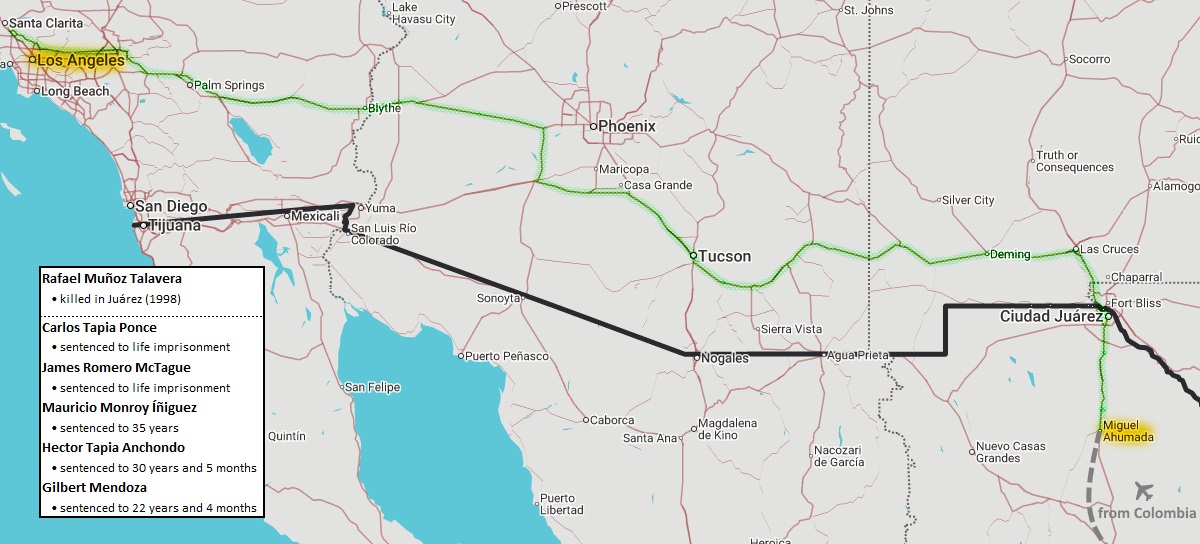
While the drugs belonged to the Medellín Cartel, transportation from Mexico into the United States was handled by a well-known trafficker with U.S. citizenship, Rafael Muñoz Talavera (the brother-in-law of the aforementioned Rafael Aguilar). That he was among the prominent figures in the Mexican-American drug trade is underscored by the fact that Muñoz and his brother owned businesses and real estate in Juárez worth $23 million. Of course, the powerful thirty-six-year-old trafficker was not the one moving the goods. He delegated that job to other criminals led by Carlos Tapia Ponce.
A former Mexican customs officer, Ponce initially smuggled marijuana from El Paso to Dallas but quickly shifted to far more profitable cocaine. For that purpose, he created a small—literally family—criminal organization. His right-hand man was his son, Héctor Tapia Anchondo, who oversaw the day-to-day affairs of their illegal business. Operations at the Sylmar warehouse were handled by Ponce’s sons-in-law, James Romero McTague and Mauricio Monroy Íñiguez. The only important member of the group who was not tied to the others by family was the driver, Gilbert Mendoza.
The cocaine first traveled to a ranch with an airstrip near the Mexican town of Miguel Ahumada, where Muñoz Talavera and his brothers took possession of it. Then came roughly an hour’s drive north on the highway to Juárez, where the Colombian product was prepared for transport through the border crossing. It was hardly difficult work. Because U.S. customs officers are able to inspect only about one out of every ten vehicles entering their country, smugglers always enjoy a tremendous advantage. Given the enormous margins, they could have lost half the drugs and still remained highly profitable. Muñoz’s organization also bribed some customs officers, so no one inspected his vehicles.
Every evening, Monday through Friday, four or five Ford LTDs or Oldsmobile Cutlass Sierras headed for El Paso, their trunks crammed with drugs. Each of these cars carried 150 to 170 kilos of cocaine. Once they crossed the Mexican-American border, they drove to a warehouse in El Paso, where Tapia Ponce’s organization took over.
On Saturday afternoon, the entire load was hidden in a semi-truck that ostensibly transported worthless paintings and similar goods for a fictitious New Mexico company, Ruidoso Arts and Crafts. Sunday was devoted to the trip from El Paso to Los Angeles, involving several team members. While twenty-eight-year-old Gilbert Mendoza sat behind the wheel of the truck, Héctor Tapia Anchondo and other members of the organization drove ahead of him in their Jaguars, Mustangs, and BMWs to scout and adjust the route. In this way they were able to avoid every checkpoint where dogs trained to detect narcotics lay in wait. Once this multi-member team—equipped, among other things, with anti-eavesdropping devices—arrived in Los Angeles, it headed to one of its three warehouses, including the one in Sylmar. The final step was handing the goods over to the Colombians. But they never got their hands on the last shipments, with a total weight exceeding 21 tons. They were simply too slow.
The Losers
The subsequent investigation revealed that the Mexican traffickers refused to hand the cocaine over to their Colombian partners until they paid for previous shipments. Because smuggling cash is more complicated than smuggling drugs due to its greater bulk, it typically took Colombian cartels a relatively long time to pay the Mexicans for their services. The goods in Sylmar were thus held hostage—long enough that law enforcement ultimately came to claim the undelivered shipments.
But U.S. authorities could not celebrate without worry, either. After the record bust in Sylmar, a classic interagency battle erupted over credit and money. The opening shot in the conflict between agencies was fired by the notorious LAPD chief Daryl Gates. Although the LAPD did not participate in the raid at all, Gates rushed to the press conference in Sylmar and commandeered all attention for himself. He also said that his department should receive at least two million dollars from the twelve million seized.
Even though the entire operation was carried out by representatives of five smaller departments (Arcadia, Bell, Huntington Park, Maywood, and South Gate), in cooperation with two DEA agents, the local police forces lost not only the credit but also almost all the seized money, because the DEA kept it. In the end, however, the DEA itself joined the crowd of losers.
Once again, it was confirmed that seizing drugs has no effect whatsoever on their availability—or, consequently, on the number of users. The DEA also once again demonstrated that it has no idea how much illegal narcotics are actually produced and smuggled into the United States. Just as after the legendary raid on gigantic marijuana fields in the Mexican state of Chihuahua in 1984, this time, too, all DEA estimates (and those of other agencies) proved utterly naive and wrong.
At the time, the DEA assumed that 400 tons of cocaine were produced annually in South America. Some agency representatives also estimated that annual consumption in the United States was 100 tons of cocaine. But all of those estimates were blown apart by the seizure of more than 21 tons in the Sylmar warehouse. Not to mention that the accounting records that were found revealed an even greater secret. The completely unknown Tapia Ponce Organization—founded only a few years earlier—had in fact transported 76 tons of cocaine to Los Angeles. In the previous three months alone.
Sources:
Angele, Al. Oversight of federal law enforcement assistance programs administered by the Department of Justice : hearings before the Government Information, Justice, and Agriculture Subcommittee of the Committee on Government Operations, House of Representatives, One Hundred First Congress, first and second sessions. 1990-05-30.
Bureau of International Narcotics Matters. International narcotics control strategy report. April 1994.
Connelly, Michael and Eric Malnic. Record 20 Tons of Cocaine Seized : Tip Leads to $6 Billion Worth of Drug Stashed in Sylmar Building. Los Angeles Times. 1989-09-30.
Connelly, Michael. Cocaine Cache Traced to Mexican Middleman : Record Seizure Also Sparks a High-Level Review of Official Drug Volume Estimates. Los Angeles Times. 1989-10-07.
Connelly, Michael. Law Agencies Differ on Credit for Big Drug Bust. Los Angeles Times. 1989-10-08.
Constantine, Thomas. The drug trade in Mexico and implications for U.S.-Mexican relations : hearing before the Committee on Foreign Relations, United States Senate, One Hundred Fourth Congress, first session. 1995-08-08.
Darling, Juanita and Michael Connelly. 30 Arrest Warrants Issued in U.S.-Mexico Drug Probe : Narcotics: Ring shipped more than 200 tons of cocaine into L.A. over two years, investigation shows. Los Angeles Times. 1992-03-11.
Draper, Robert. Carrillo’s Crossing. Texas Monthly. December 1995.
Drug Enforcement Administration. The Drug Enforcement Administration (DEA) 1985-1990. 2021.
Soble, Ronald L. Sylmar Drug Ring ‘Patriarch’ Gets Life : Narcotics: A raid on his warehouse netted a record 21.4 tons of cocaine. Judge imposes maximum term without parole. Los Angeles Times. 1991-04-16.
USA vs. Carlos Tapia Ponce et al. Appeals from the United States District Court for the Central District of California. No. 51 F.3d 820 (9th Cir. 1995). 1995-03-27.
USA vs. Gilbert Mendoza. Appeal from the United States District Court for the Central District of California. No. 78 F.3d 460 (9th Cir. 1996). 1996-03-11.