When Héctor Palma Salazar received a box containing his wife’s severed head, many people took it as confirmation that the battle among Mexican drug traffickers was intensifying. The first incident of this kind, however, had one fundamental flaw—one the public largely has no idea about. It never happened.
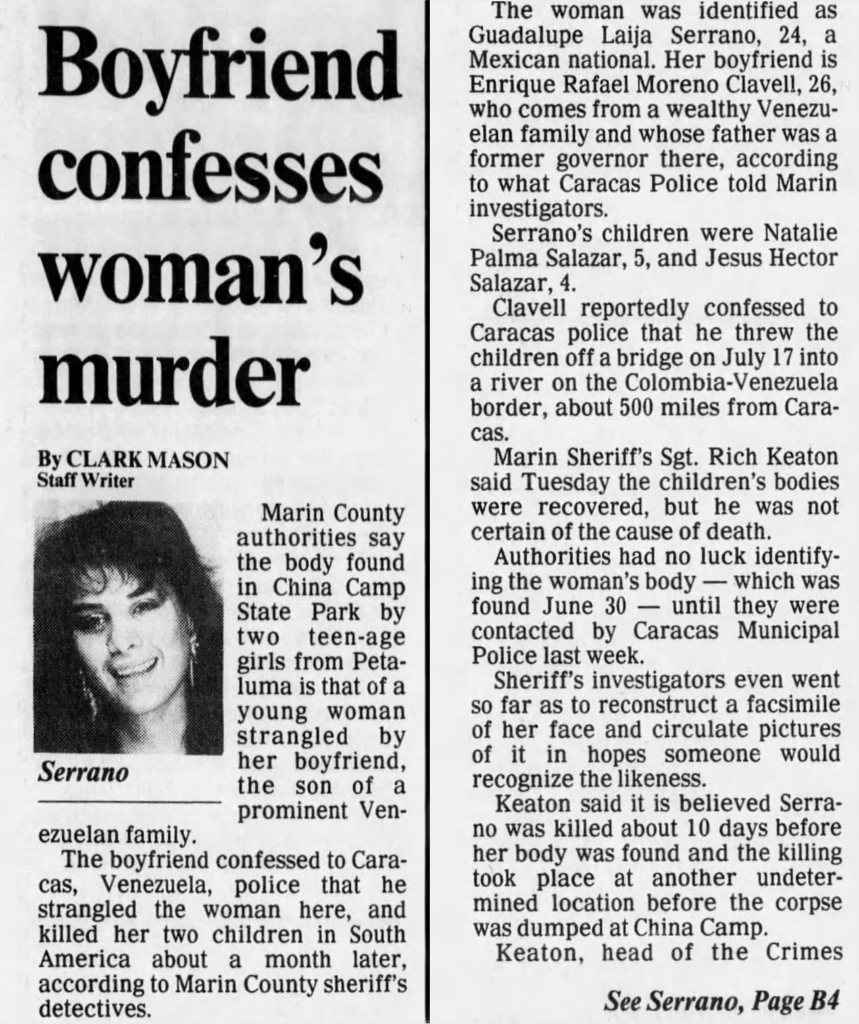
Guadalupe Laija Serrano, the wife of the drug lord known as El Güero, was indeed murdered in the summer of 1989, but the circumstances of her death became one of the biggest myths in Mexican drug trafficking. To some extent, that was due to the fact that the murder took place outside Mexico—in sunny California near San Francisco—where Laija had fled with her lover.
That lover was an ordinary Venezuelan criminal, Enrique Clavel Moreno, who had originally come to Mexico to study. In Culiacán he first became involved with Palma’s sister, through whom he met Guadalupe Laija. A passionate womanizer, he sensed yet another prey he could not resist.
Laija did not resist the affair with the handsome young man from Venezuela. Not even the fact that she and her husband had two preschool-aged children changed that. In a way, it was no surprise, because Palma Salazar spent more time behind bars than free with his family. In the end, it fell apart in a tragic way.
Guadalupe Laija Serrano took her children, Nataly and Jesús, and fled with Clavel to Venezuela. From South America they returned north regularly—but not to Mexico. Instead, they went to the United States, where Laija even owned a house. Thanks to the narco-dollars of her husband, one of the biggest Mexican traffickers of his time, she could afford regular trips to California, where she and Clavel spent money on luxury clothing, jewelry, and cars. But from one of those visits to the U.S., she never returned.
On the last day of June 1989, two young visitors to China Camp State Park in Marin County, north of San Francisco, came across a corpse. Because the body of the strangled woman was in an advanced state of decomposition, local investigators tried to create an approximation of her face. Yet no one was able to identify the victim from the facsimile images published in the media. She was a Mexican woman whom Marin County residents could not have known. Her identity was discovered only after an even worse fate befell her children.
After the murder, Clavel returned to Venezuela, where he also took the lives of Nataly and Jesús—doing so in a way that shocked the entire country. A month after the murder in the United States, he went with the small children of Héctor Palma Salazar and the murdered Guadalupe Laija to a high viaduct in the city of San Cristóbal, from which he threw both children.
The hunt for the perpetrator of the brutal double murder of the small children did not take long. Thanks to an employee of one of the local hotels who remembered the children from the previous year, it was possible to identify not only the killer but also Laija, whose murder American authorities had been unable to solve. The horrific case was thus resolved relatively quickly. In Mexico, however, the entire story began to take on a life of its own.
Myth
Enrique Clavel confessed to Venezuelan investigators to all three murders, cooperated with them in reconstructing the crime, and claimed that he had argued with his girlfriend before flying to the United States. According to records from the time, everything suggests that Laija wanted to return to her husband, which drove the psychopathic Clavel into a murderous frenzy. Even so, stories full of sadism and revenge among drug lords began spreading in Mexico.
Claims that Clavel first drugged and sexually abused the children before throwing them off the bridge are contradicted by the investigative conclusions reached by Venezuelan authorities at the time. And the endlessly repeated myth that the killer sent the murdered Laija’s head to her husband is demolished by contemporaneous statements not only from Venezuelan but also American investigators. After all, American authorities could hardly have created a facial approximation of a headless victim.
For decades, the triple murder has ranked among the best-known incidents in the history of the drug wars, even though the most shocking details—in an already horrific crime—are pure invention. The same is true of Palma Salazar’s alleged acts of revenge, which were supposedly to have reached even the killer himself. Enrique Clavel did in fact die not long after being imprisoned, but it certainly was not a murder ordered by El Güero, as the legend claims. The young sociopath was shot during an attempted escape from a Venezuelan prison along with three other inmates.

The myth also says that Clavel was merely a planted pawn meant to seduce Laija and steal millions of dollars from her, which would have ended up in the account of his alleged boss, Miguel Félix Gallardo. This story, too, runs into a dead end, because Clavel lived with his girlfriend for at least a year. If his task had been to seduce her, rob her, and kill her, he certainly would not have waited that long—let alone if such stalling would have been acceptable to his supposed criminal boss.
False information appeared in the media for so long that it ultimately became “truth”. Anyone interested in Mexican drug trafficking thus knows the alleged rivalry between Héctor Palma Salazar and Félix Gallardo, which supposedly cost many people in the latter trafficker’s circle their lives. But it was Félix himself who, twenty years later, revealed who stood behind the murders of his relatives and lawyers.
While Mexican authorities, in cooperation with the media, attributed the series of killings to the revenge-hungry El Güero, Félix claimed the perpetrators were federal police officers led by the notoriously infamous prosecutor Javier Coello Trejo. His gang of dirty cops supposedly robbed Félix continuously after his arrest in the spring of 1989, until his family members and legal representatives began disappearing as well. Miguel Félix Gallardo described the horrifying methods of the greedy federal agents in detail, and in his 35-page memoirs secretly written in prison he did not mention any connection to Palma even once. Why would he?
Sources:
Busse, Jane. Culiacán Vice. Exceso. February 1991.
Hernández, Armando. Abatidos los cuatro reclusos que participaron en la fuga. La Nación. 1991-05-18.
Hernández, Armando. Aislado en celda de máxima seguridad el monstruo del Viaducto. La Nación. 1989-08-01.
Hernández, Armando. El monstruo estranguló a su mujer en EUA y vino a San Cristóbal para asesinar a los menorcitos. La Nación. 1989-07-28.
Hernández, Armando. El monstruo recontruyó asesinato de los niños. La Nación. 1989-07-30.
Hernández, Armando. Fueron sacados de sus camas para llevarlos a la muerte. La Nación. 1989-07-29.
Hernández, Armando. Lanzaron del viaducto 2 niños de 5 y 6 años. La Nación. 1989-07-19.
Hernández, Armando. Madre de los pequeños lanzados desde el viaducto podría haber sido asesinada antes del hecho. La Nación. 1989-07-21.
Hernández, Armando. Teme ser asesinado monstruo del viaducto. La Nación. 1989-07-31.
Hernández, Armando. Trasladado a San Cristóbal asesino de los dos niños. La Nación. 1989-07-27.
Mason, Clark. Boyfriend confesses woman’s murder. The Press Democrat. 1989-08-02.
Osorno, Diego Enrique. Memorias del Jefe de Jefes. Gatopardo. May 2009.