Fentanyl caused the worst drug epidemic in history, claiming the lives of roughly half a million Americans between 2015 and 2025 alone. Yet before it erupted, ten years earlier, the same fentanyl disaster briefly occurred on a smaller scale, caused by one small Mexican trafficking organization. Although its actions led to the deaths of many people, it also provided the world with valuable insights into the tragic dangers of drug prohibition laws. In vain.
When seven-year-old Mexican boy Ricardo Valdez Torres moved to San Diego with his parents in 1961, an easy life did not await him. He grew up in a family that was far from ideal. When his father left the family, responsibility for six siblings and several nephews fell to his sister, who devoted more attention to her drug addiction. Growing up in a dysfunctional family sent Valdez down a slippery slope from which he never recovered—despite his talent.
He did use that talent, but in a very different way than would have been desirable. In the 1980s, he began producing fentanyl domestically, which of course did not escape the attention of law enforcement. In 1993, he was sentenced to prison, and after ten years behind bars he was deported to Mexico.
He settled in Toluca, a metropolitan area of two million people in central Mexico, where he immediately returned to a life of crime. He joined the ranks of a rather insignificant trafficking organization led by a man named Felixito Vidaña Aispuro. In 2003, Vidaña decided to start smuggling into the United States a substance with which no Mexican had any experience. Except Valdez.
Valdez was first tasked with setting up a company that would be used to purchase equipment and chemicals needed to manufacture fentanyl. He therefore joined forces with his friend Óscar Rivera Peralta, and together they founded Distribuidora Talios S.A. de C.V. Through this company, they ordered N-phenethyl-4-piperidone from China, which was shipped to their laboratory at S. Rafael 72, Isidro Fabela, Lerma de Villada.
By mid-2005, Ricardo Valdez had completed the first batches of fentanyl. The next step therefore fell to his colleagues from the Vidaña Aispuro Organization, who smuggled the fentanyl into Chicago, where they had long been distributing heroin. In the summer of 2005, Mexican fentanyl thus appeared on the American market for the first time.
The New Heroin
In July, a wholesale drug distributor in the Great Lakes region, Guadalupe Moreno Soto, received a sample of the so-called new heroin. Before traveling from Chicago to his customer in Detroit, he decided to try it himself. But because he had no idea that the “heroin” was actually fentanyl, he ended up not in Michigan but in a Chicago hospital.
A certain amateurishness was also displayed by DEA agents, who had coincidentally been monitoring Moreno for some time. As soon as the Chicago trafficker was released from the hospital, he finally set out for Detroit, which the anti-drug agents naturally did not miss. However, they never reached Michigan’s largest city, because Moreno’s car disappeared from their sight on the way to Detroit.
Since Moreno’s customers in Chicago and Detroit were satisfied with the “new heroin,” he arranged regular deliveries with representatives of the Vidaña Aispuro Organization. Specifically, this involved four kilograms of fentanyl per month at a price of $500,000 per kilogram. The same amount of heroin sells for barely a tenth of that, but fentanyl is about fifty times more potent—and therefore more profitable. The problem with the drug trade, however, is that no one can know exactly what they are actually buying. As all participants in the fentanyl chain were soon to discover.
Although the substance being traded by these traffickers at the turn of 2005 and 2006 was unusual, the method of distribution was exactly the same as with ordinary drugs. Illegal substances pass through many levels, where they are always modified—usually diluted to increase volume, though sometimes mixed with fentanyl to increase potency.
Once chemist Ricardo Valdez Torres produced the fentanyl, Moreno purchased it from the Vidaña Aispuro Organization and sold it to wholesale distributors in individual cities. Among his customers in Chicago was Antonio Duran, from whom the fentanyl made its way to Derrick Campbell, a member of the Mickey Cobras street gang on Chicago’s South Side. From him, the “new heroin” was purchased by James Austin, the head of one of the Mickey Cobras’ cells, whose dealers sold it to heroin users in the Dearborn Homes housing complex.
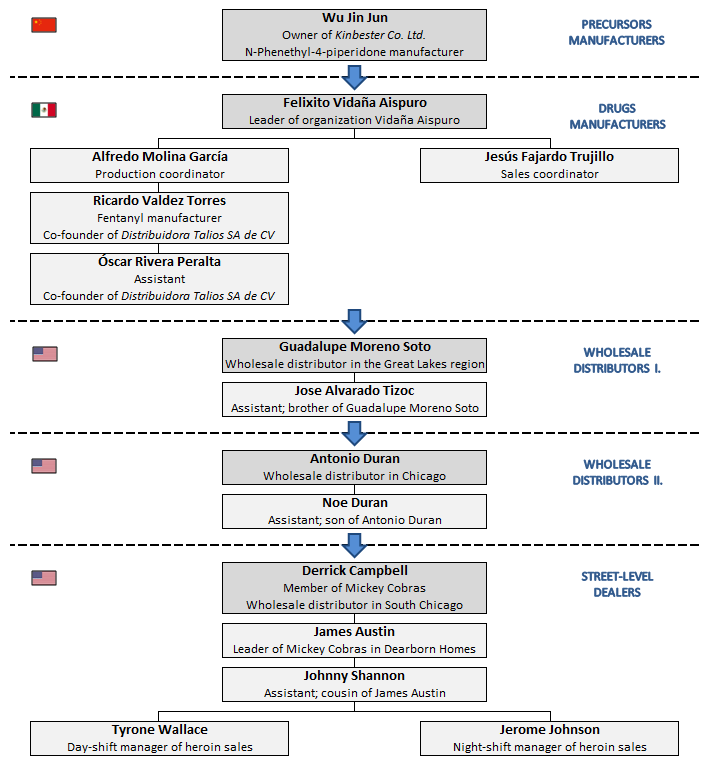
This diagram shows one of the many paths fentanyl had to travel before reaching the end user. All illegal substances pass through so many hands that, aside from the first link in the chain, no one has any idea how strong the drug they are buying actually is. The consequences are tragic even with methamphetamine, cocaine, or heroin—let alone fentanyl.
After his arrest, James Austin told investigators that the heroin from Campbell was so strong that he had to dilute it at a ratio of 10:1, something he had never done before. He had no idea that the heroin—which his predecessors at all levels had already diluted many times over—was in fact fentanyl. He realized the truth only when it was too late.
In March 2006, one of the members of the Vidaña Aispuro Organization visited a DEA office to alert agents to the fentanyl laboratory in the heart of Mexico. The DEA did not hesitate and immediately passed the verified information on to Mexican federal authorities, who dismantled Vidaña’s organization on May 21. During the raid on the laboratory, fentanyl pioneer Valdez Torres was also arrested and, four years later, extradited to the United States.
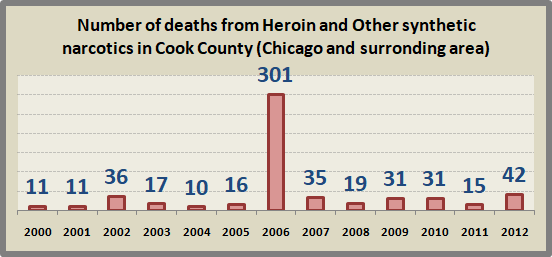
His product killed at least 1,013 people in Chicago, Detroit, Philadelphia, and other cities over a short period of time. At the same time, it demonstrated the desperate dysfunction of drug prohibition, which not only has no effect on the availability of illegal substances or the number of their users, but actually makes the entire situation significantly worse. Yet no one learned from the deadly consequences of the absence of a strictly regulated market for cocaine, methamphetamine, or heroin. So fentanyl returned ten years later, and it struck with full force.
Sources:
Centers for Disease Control and Prevention. Multiple Cause of Death, 1999-2020. ICD-10 Codes: T40.1; T40.4. Cook County, IL (17031). https://wonder.cdc.gov/mcd-icd10.html.
Herrera, Luis. Fentanilo, la amenaza crece. Reporte Indigo. 2016-08-17.
Rapaszky, Ryan J. USA vs. Jose de Jesus Alvarado Tizoc, Criminal Complaint. United States District Court, Northern District of Illinois, Eastern Division. No. 08 CR 124. 2008-02-12.
Schaefer, Jim and Joe Swickard. A deadly path Fentanyl-laced heroin left fatalities nationwide. Lowell Sun. 2019-07-13.
Svilar, William. USA vs. James Austin et al., Criminal Complaint. United States District Court, Northern District of Illinois, Eastern Division. No. 06 CR 0451. 2006-06-20.
USA vs. Lutgardo Chavez, Jr. et al. Superseding Indictment. United States District Court, Northern District of Illinois, Eastern Division. No. 06 CR 138. 2007-02-22.
USA vs. Ricardo Valdez Torres. Plea Agreement. United States District Court, Northern District of Illinois, Eastern Division. No. 06 CR 138. 2015-02-25.
Whalen, Jeanne and Brian Spegele. The Chinese Connection Fueling America’s Fentanyl Crisis. The Wall Street Journal. 2016-06-23.