A stay in a Mexican prison usually doesn’t force Mexican drug lords to change their lifestyle, because even behind bars they can indulge in wild parties featuring prostitutes or live bands. But all the fun ends the moment they are extradited to the United States. That’s when the hard times begin.
Of course, it would be nonsense to claim that corruption doesn’t exist in the U.S.—whether in prison or outside it. A textbook example was the notorious rapist Jeffrey Epstein. He used his money and influence so that in 2008, for sexually abusing underage girls, he was sentenced to a laughable 13 months in an elegant private wing of a Florida jail, which he was moreover allowed to leave six times a week for 12 hours at a time.
Foreign criminals have to forget about privileges like that. Because in the U.S., unlike back home, they have neither power nor important contacts, they are not entitled to VIP treatment. In American prisons, they become ordinary inmates, and no one shows them mercy—unless they have something to offer the government.
Harold Poveda Ortega, a Colombian intermediary between Mexican and South American cocaine traffickers, reached a plea agreement after being extradited to the U.S. Among other things, he agreed not to commit any further crimes, or the deal could be voided. Yet before the ink on the agreement had even dried, Poveda bribed a guard with two thousand dollars to arrange expanded visiting privileges for him.
But his actions had absolutely no consequences. After taking the bribe, the guard didn’t arrange any extra visits for him, and the American government remained just as indifferent, enthusiastically using Poveda as a witness in the following years.
A similar story was written by Pedro Flores, a Chicago drug distributor for the Sinaloa cartel. He didn’t care about laws or rules even after he and his brother began cooperating with the DEA. When DEA agents and his wife visited him in pretrial detention, none of the law-enforcement representatives somehow noticed that he left with his wife for the restroom, where he got her pregnant.
While the American government overlooked his constant rule-breaking in custody, it took a different view of his earlier conduct. Shortly after Pedro and Margarito Flores began working with U.S. authorities, they concealed one of the newly arrived cocaine shipments. Pedro then used part of the millions of dollars in proceeds in his own trademark way—he bought his wife a new Bentley. The judge didn’t forget the brothers’ brazenness and added two more years to the originally planned twelve-year prison sentence.
In any case, world-famous criminals whom the government has no intention of using as witnesses fare much worse.
Without Mercy
Rafael Caro Quintero became infamous above all for the murder of DEA agent Camarena in 1985. Since then he spent most of his time in a Mexican prison, but many Americans hoped he would pay for his crime in the United States. After forty years of waiting, they finally got their wish.
In New York, Caro Quintero was placed in pretrial detention, where he ended up under a strict regime known by the acronym SAM (Special Administrative Measures). This tool is used primarily for terrorists, but the attorney general concluded that the seventy-one-year-old former drug trafficker was similarly dangerous.
The strict isolation under SAM ultimately led to a rather curious complaint. The court-appointed attorneys said that their client not only has almost no contact with other people, but also cannot watch television because there isn’t one in his cell. He does have a radio available, but he hardly uses it because he doesn’t understand English. And last but not least, he can’t really read properly either, because the local selection of literature doesn’t match his reading ability: Rafael Caro Quintero had major problems completing first grade of elementary school.
Joaquín Guzmán Loera also ended up under the SAM regime after his life sentence, when he was transferred to ADMAX Florence, a prison for the most dangerous criminals. El Chapo described his life in solitary confinement in his twenty-page complaint, where he lamented that in seven whole years he hadn’t seen the sun even once. His time outside his cell lasts at most three hours a week—if he’s lucky. Most of the time, the guards don’t even let him into his small outdoor cage. He also alleges they withhold his mail, which is his only means of long-distance communication. The former head of the Sinaloa cartel likewise complained that guards intentionally wake him up several times a night, every day, by pumping extremely hot air into his cell.
El Chapo did not fail to mention inadequate medical care, terrible food, and zero opportunity for any activity. So the only thing he does all day is sit on his bed and stare at the wall. He summed up his situation as mental, psychological, emotional, and physical torture—of a kind not even Adolf Hitler committed.
But total isolation also has its upsides, since interactions with fellow inmates can be somewhat complicated. Osiel Cárdenas Guillén, the former head of the Gulf Cartel, knows this firsthand. The criminal known by the nickname El Mata Amigos was sentenced to only 25 years thanks to his cooperation with authorities, but even so his time behind bars was not entirely trouble-free.
In early September 2019, members of the American prison gang the Mexican Mafia came into his cell and demanded money. When Cárdenas refused to comply, a certain Francisco Garcia began beating him, and in a rather brutal manner. He didn’t stop even when guards ran into the cell. They subdued the aggressor only with the use of pepper spray.
Osiel Cárdenas could count himself very lucky that he escaped the attack with only a broken nose and a short hospital stay. Francisco Garcia, on the other hand, earned himself an additional five years in prison on top of his sentence.
It’s no wonder that the corrupt former minister of public security Genaro García Luna wanted to avoid similar unpleasantness at any cost. In Mexico he was seen as a key ally of the Americans in the war on drugs, but because he was also taking bribes from the Sinaloa cartel, he was arrested in the United States in 2019. Luna did not intend to sit idly by while awaiting the expected verdict. So in New York detention, he launched a very bizarre game.
He asked one of his fellow inmates to issue a statement claiming that he had allegedly overheard witnesses from Luna’s trial conspiring to give false testimony. The problem, however, was that Luna chose as his accomplice a pedophile diagnosed with a psychotic disorder accompanied by hallucinations. But that was far from all.
To lend credibility to his fake story about a conspiracy, Luna made the same request to another fellow inmate. This one did not suffer from hallucinations, nor did he force small children into sexual acts—but he secretly recorded his conversations with Luna on a mobile phone. And because he provided the recordings to the authorities, Luna’s entire operation ended in a complete fiasco.
Genaro García Luna was sentenced to 38 years in prison and was sent to ADMAX Florence to join his former partner El Chapo. Although given Guzmán’s strict regime, it is very likely that they will never meet within the prison.
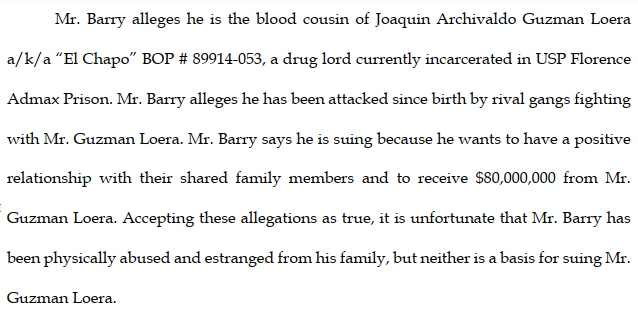
But even total isolation doesn’t mean Joaquín Guzmán Loera is completely out of reach of other inmates. Unlike Osiel Cárdenas, he is not threatened by a physical attack, but even from a distance American criminals may try to rob him. In 2023, one of the most powerful drug traffickers in history was sued by a certain Scott Thomas Barry. The Indiana inmate claimed to be El Chapo’s blood cousin. For that reason, he said, he had been attacked by Guzmán’s rivals since birth, which ultimately forced him to seek compensation. It must be said that Barry was certainly not thinking small. He demanded $80 million from Joaquín Guzmán.
Sources:
Baltz, Holly. Jeffrey Epstein timeline: How the Florida case led to 15 more years of sex abuse. The Palm Beach Post. 2025-07-08.
DeMarco, Mark. USA vs. Rafael Caro Quintero, 15 Cr. 208 (FB). 2025-08-08.
Goudie, Chuck and Barb Markoff. Flores brothers get 14 years on drug charges. ABC 7. 2015-01-27.
Guzmán, Joaquín Loera. [Letter to Clerk of Court]. 2024-07-17.
Scott Thomas Barry vs. Joaquín Archivaldo Guzmán Loera, March Fernich and Julie Roush. Opinion and Order. United States District Court, Northern District of Indiana, Fort Wayne Division. No. 1:23-CV-534-DRL-MGG. 2024-02-13.
Sharp, Sonja. Jurors in ‘El Chapo’ trial hear a recording of a drug deal. Los Angeles Times. 2018-12-19.
USA vs. Alfredo Beltrán Leyva. Transcript of evidentiary hearing before the honorable J. Leon United States district judge. United States District Court for the District of Columbia. CR No. 12-184. 2017-02-14.
USA vs. Francisco Garcia. Reporter’s Transcript (Sentencing Hearing). United States District Court for the District of Colorado. No. 21-cr-00143-RM. 2022-11-22.
USA vs. Genaro García Luna. Memorandum Decision and Order. United States District Court, Eastern District of New York. 19-cr-576 (BMC). 2024-08-06.
USA vs. Pedro Flores and Margarito Flores. Government‘s Sentencing Memorandum and Motion to Depart from the applicable guideline range. United States District Court, Northern District of Illinois Eastern Division. No. 09 CR 383. 2015-01-04.